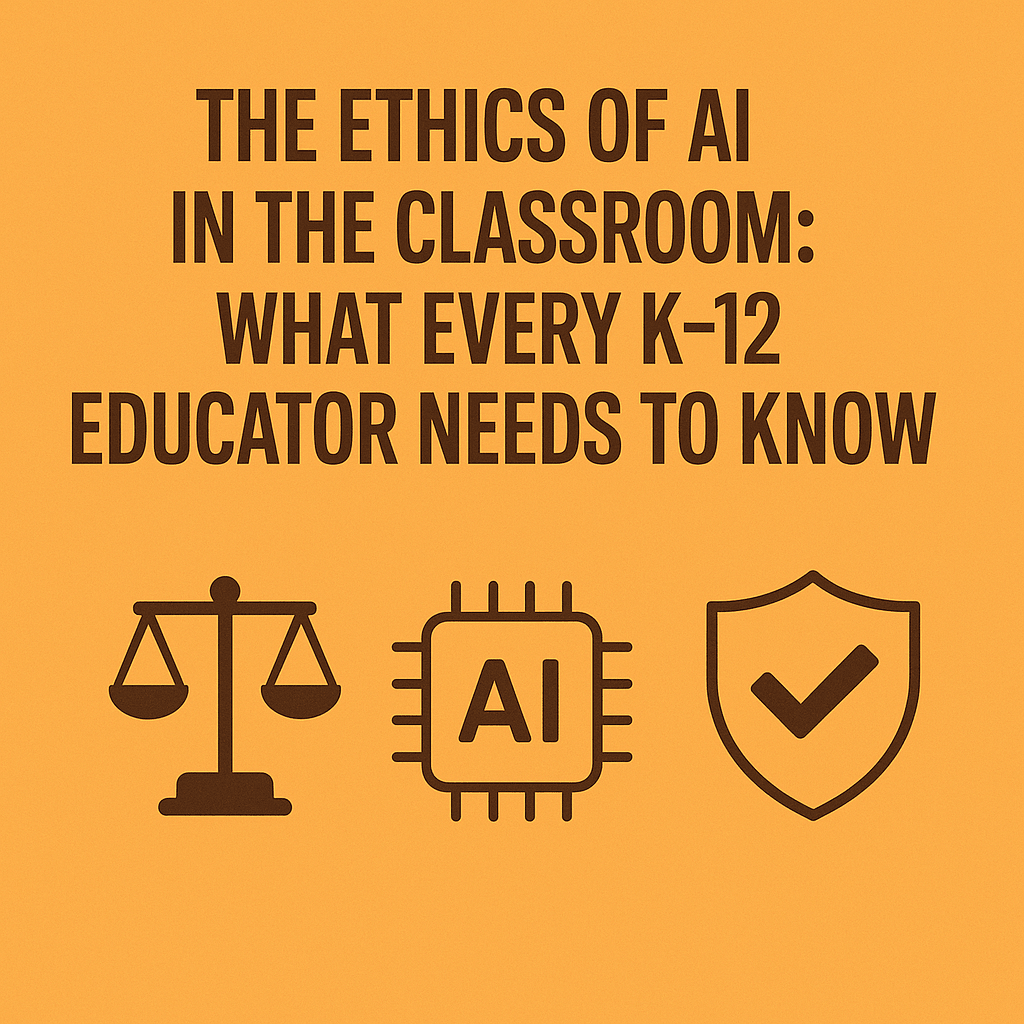
The Ethics of AI in the Classroom: What Every K–12 Educator Needs to Know - As generative AI tools flood into schools, many K–12 educators are caught between curiosity and concern. On one hand, these tools offer exciting opportunities to personalize learning, enhance creativity, and streamline instruction. On the other hand, they raise serious questions about privacy, bias, transparency, and accountability.
At the heart of these questions lies a critical challenge: how do we ensure the ethical use of AI in education, especially for our youngest learners?
The Stakes Are High
Unlike other digital tools, AI doesn’t just deliver content—it makes decisions, generates language, and learns from patterns. This introduces new ethical dimensions that go beyond acceptable use. In K–12 classrooms, where students’ rights and vulnerabilities are paramount, those dimensions demand clarity and care.
Educators, administrators, and policymakers must move beyond whether to use AI, and start asking how to use it responsibly.
Key Ethical Considerations for K–12 Classrooms
🔐 1. Privacy and Data Protection
AI tools often collect and process sensitive data—student names, responses, behavioral patterns, and more. If misused, this information could be stored, sold, or leaked.
In the U.S., laws like FERPA, COPPA, and SOPPA provide a legal framework, but compliance is not the same as ethics. Schools must go further by:
Using only district-approved tools with clear data policies,
Avoiding tools that train on user input unless opted out,
Teaching students to never enter personal or identifying information into AI systems.
⚖️ 2. Bias and Fairness
AI tools learn from the internet—which means they inherit its biases. Gender stereotypes, racial disparities, and cultural misrepresentations can surface in AI-generated content, even in subtle forms.
Teachers must:
Review AI outputs for bias before using them with students,
Discuss bias openly with students to build critical AI literacy,
Use diverse prompts and perspectives to test AI responses for fairness.
According to UNESCO, addressing bias in AI tools is not a technical task alone—it's a moral imperative (UNESCO AI Ethics Report, 2021).
🧾 3. Transparency and Disclosure
Students and teachers alike need clear guidelines on when and how to disclose AI use. If a student uses AI to brainstorm ideas, outline a response, or summarize a source, should that be cited? If a teacher uses AI to draft feedback, should it be disclosed?
Transparency builds trust and teaches digital responsibility. Consider:
Requiring “AI Use Declarations” with student submissions,
Modeling disclosure as an educator (e.g., “This rubric was AI-assisted.”),
Developing school-wide expectations for transparency.
🧑🏫 4. The Role of the Teacher
Ethical AI use in education means maintaining human judgment at the center of learning. Teachers must not abdicate responsibility for what students see, create, or are assessed on.
AI can assist, but it should never:
Make decisions about grades without human review,
Replace teacher-led discussion or feedback entirely,
Generate content that hasn’t been critically evaluated for age and context.
Ethical integration means AI supports pedagogy, not the other way around.
Why Schools Need Clear AI Policies Now
Waiting for national or state legislation is not enough. School systems should develop AI policies tailored to K–12 settings. These should include:
Tool vetting and approval processes (aligned with privacy laws),
Guidelines for student use, including age-appropriate access,
Expectations for educator use, including transparency and bias mitigation,
Disciplinary procedures for misuse, framed in restorative terms.
The Brookings Institution urges schools to act now by creating internal task forces, offering professional learning, and building flexible, evolving policies to help teach The Ethics of AI in the Classroom: What Every K–12 Educator Needs to Know
Benefits of Ethical AI Use in Schools
✅ Builds student trust and digital citizenship
✅ Promotes equity by acknowledging and correcting bias
✅ Encourages responsible tech habits from a young age
✅ Aligns school values with evolving digital norms
✅ Prevents legal and reputational risk
Pitfalls to Avoid
🚫 Using unapproved or opaque AI tools with students
🚫 Treating AI tools as neutral or infallible
🚫 Failing to educate staff on AI ethics
🚫 Over-relying on vendors for guidance without internal vetting
Ethical lapses with AI are often not malicious—they stem from lack of clarity or training. That’s why proactive planning is essential.
Conclusion: Lead with Ethics, Teach with Integrity
The Ethics of AI in the Classroom: What Every K–12 Educator Needs to Know - The rise of generative AI in education is not just a tech challenge—it’s an ethical moment. Schools that lead with values like transparency, fairness, and student protection will be best positioned to harness AI’s potential while minimizing harm.
The goal isn’t just to use AI responsibly—it’s to help students learn what responsibility looks like in a digital age. The Ethics of AI in the Classroom: What Every K–12 Educator Needs to Know is a complicated concept. Find out more at www.myibsource.com