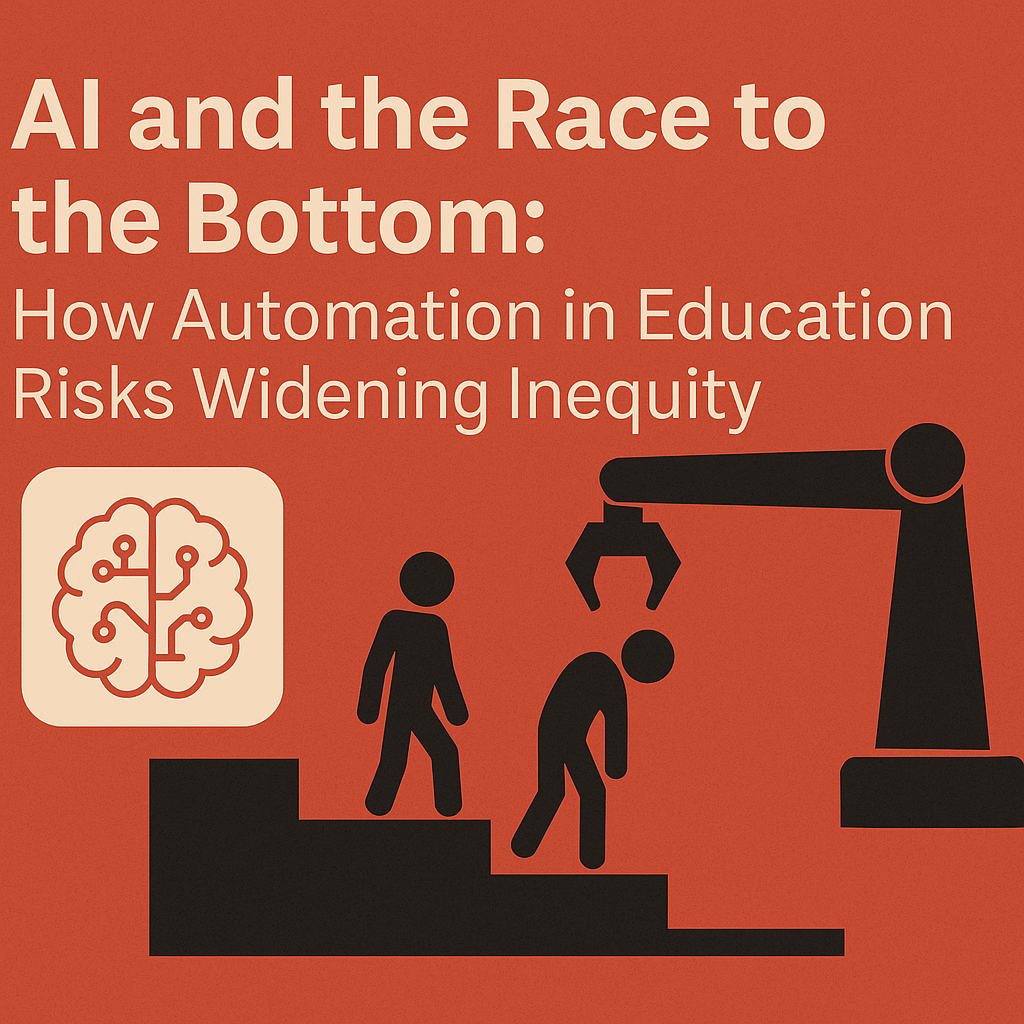
AI and the Race to the Bottom - As generative AI becomes more common in schools, leaders are facing pressure to do more with less. AI tools promise automated grading, on-demand tutoring, and personalized content—often at a fraction of the cost of human labor. But when the primary goal becomes saving money, education risks entering a dangerous phase: a race to the bottom.
This isn’t just a budget concern. It’s an equity crisis in the making. When cost-cutting with AI in schools takes precedence over educational justice, the result may be more automation for underserved communities—and more human support for the privileged.
We must ask: Who is this technology for? And what kind of learning does it promote?
The Hidden Inequities Behind AI Hype
On its surface, AI seems like a democratizing force. It can:
Offer students 24/7 academic help,
Translate materials across languages,
Adjust learning levels dynamically.
But under the hood, generative AI still depends on:
High-quality prompts,
Critical thinking to evaluate outputs,
Reliable infrastructure and bandwidth,
Thoughtful, well-trained human facilitators.
Students in well-resourced schools are more likely to get curated AI integration—paired with strong instructional design and digital literacy. Students in underfunded schools may receive AI-as-a-substitute, replacing human interaction and instructional depth with canned feedback or unsupervised tools.
Where the “AI and the Race to the Bottom” Shows Up
💻 1. Replacing People with Platforms
Some districts are considering replacing paraprofessionals, reading coaches, or even substitute teachers with AI tools. In theory, these tools save money. In reality, they erode relational learning, especially for students who benefit most from adult support.
🧑🏫 2. Staffing Decisions Framed Around Cost, Not Care
Instead of investing in teachers, counselors, or SEL specialists, some schools are using AI to simulate support—automating feedback, emotional check-ins, or behavior reports. These tools may reinforce punitive structures, not meaningful learning.
📉 3. Low-Rigour Content for Marginalized Learners
AI-generated lessons may default to safe, neutral, or generic outputs. Without human tailoring, culturally responsive content and deeper discourse get lost. Equity becomes a checkbox—rather than a lived, nuanced practice.
Key Question: Who Gets the Human Touch?
If AI is deployed differently across schools and districts, we risk creating a two-tier system:
Tier 1: Students in affluent schools get tech + teachers. AI is used to enhance creativity, critical thinking, and personalized coaching.
Tier 2: Students in low-income or rural schools get tech instead of teachers. AI becomes a stand-in for human interaction.
That’s not innovation. That’s digital austerity—and it deepens historical educational disparities.
As Brookings cautions, technology that’s used to replace rather than empower leads to “efficiency at the expense of learning.”
What Equity-Driven AI Integration Looks Like
✅ 1. AI as a Tool, Not a Trade-Off
Use AI to augment teaching, not replace it. Ensure human educators remain central to instruction, especially in critical-thinking subjects and emotional development.
✅ 2. Community-Responsive Design
Co-create AI policies and practices with families, teachers, and students—especially in historically marginalized communities. Ask: What do they want AI to do?
✅ 3. Invest in Human Infrastructure
If AI saves time or money, reinvest that surplus into teacher training, smaller class sizes, family engagement, or counseling—not more automation.
✅ 4. Measure Impact by Equity, Not Efficiency
Don’t just track AI usage—track who benefits, how it’s used, and who’s left out. Collect disaggregated data to monitor bias and disparate outcomes.
Benefits of Equity-Centered AI Use
✅ Bridges gaps in access to resources when implemented with support
✅ Allows differentiated instruction while preserving human connection
✅ Frees up teacher time to focus on mentorship and relationships
✅ Ensures all students receive high-quality, thoughtful learning experiences
✅ Aligns with public education’s core mission: opportunity for all
Pitfalls to Avoid
🚫 Deploying AI as a cost-saver, not a learning enhancer
🚫 Offering AI “solutions” in lieu of equitable staffing or investment
🚫 Normalizing AI-only instruction in certain zip codes
🚫 Using AI-generated content without cultural relevance or oversight
Conclusion: Equity Is Not Automatic—It’s Intentional
AI and the Race to the Bottom - AI won’t fix education’s inequities—but it can amplify them if we’re not careful. If school leaders treat AI as a budgeting tool rather than a learning tool, they risk undercutting the very students who need the most support.
AI equity in education demands more than access. It requires care, oversight, and a willingness to ask hard questions about power, justice, and who deserves a human teacher.
The future of education should not be one where wealth buys wisdom and automation is all that’s left for everyone else. Let’s ensure that every student—not just the well-connected—gets to learn, grow, and thrive with people who believe in them. Find out more at www.myibsource.com