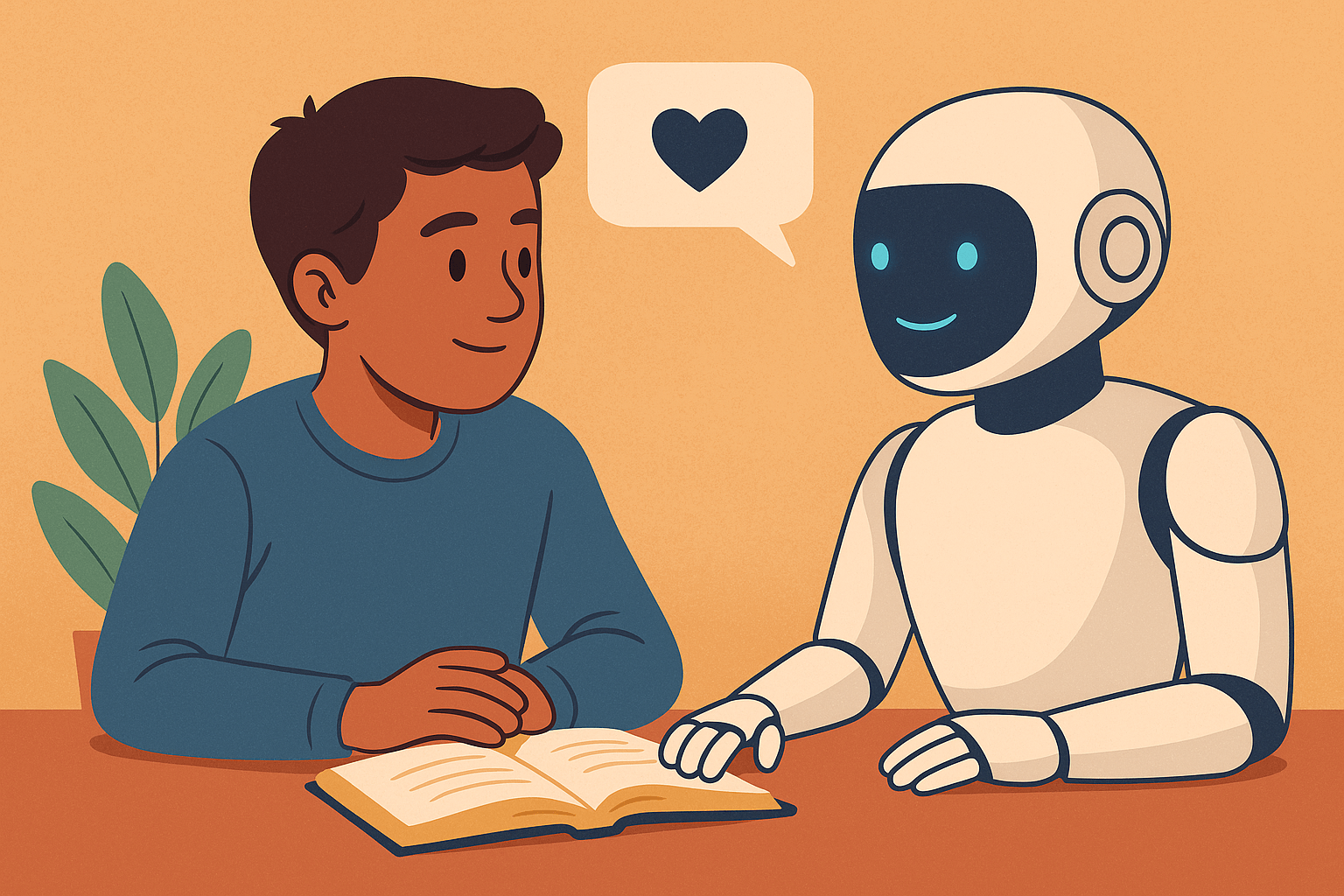
When AI Replaces Empathy - Generative AI is being hailed as a breakthrough for education—able to tutor students, provide feedback, and personalize learning at scale. But beneath the enthusiasm lies a quiet, essential question: What happens when AI begins to replace—not just assist—human connection?
In education, relationships matter. Research consistently shows that students learn best when they feel seen, heard, and emotionally supported by teachers and peers. The growing use of AI for feedback, instruction, and even emotional support raises the risk that we may automate away empathy in the pursuit of efficiency.
This article explores the tension between progress and presence—between what AI can do and what only humans should.
The Rise of AI as Companion and Caregiver
The use of AI in caregiving and emotional roles is no longer hypothetical. A 2024 Harvard Business Review survey found that the most common AI application reported by enterprise teams was not data processing or automation—but therapy and companionship.
This trend is bleeding into education, where AI tools are:
Responding to student questions with 24/7 availability,
Providing motivational prompts and emotional check-ins,
Delivering customized praise or corrections,
Simulating conversations to reduce classroom anxiety.
On paper, this sounds promising—especially in overburdened classrooms. But in practice, it risks shifting the emotional labor of teaching to machines.
What We Lose When AI Replaces Human Interaction
💬 1. Empathy and Relational Trust
Students don’t just need answers—they need to feel understood. A teacher’s nod of encouragement, a classmate’s shared frustration, or a mentor’s well-timed pause all create moments of authentic emotional resonance.
AI can simulate support, but it doesn’t truly care. Over time, overuse of AI in these roles could reduce the opportunities for students to build relationships with real people—eroding the sense of belonging and trust that learning depends on.
🧠 2. Social-Emotional Learning (SEL)
SEL isn’t a subject—it’s a set of relational skills developed through lived experience: resolving conflict, expressing emotion, listening deeply.
When AI takes over communication, feedback, or group interaction, students may miss chances to:
Practice empathy in peer relationships,
Experience emotional nuance in conversation,
Learn to read social cues in real time.
As CASEL and Seltrove Education notes, SEL must be embedded in real-world relationships, not simulated ones.
🧍 3. Teacher Presence and Modeling
Teachers model what it means to think aloud, feel deeply, and navigate complexity. When AI takes over instructional feedback, pacing, or even behavior cues, the educator’s emotional presence is sidelined.
This risks transforming teachers into facilitators of tools—rather than mentors, role models, and guides.
Why This Is Happening
The push to use AI as an emotional proxy stems from real challenges:
Student mental health needs are increasing,
Teacher burnout is at an all-time high,
Schools face chronic staffing shortages.
In this context, AI looks like a lifeline. And in moderation, it can be. But without careful boundaries, we risk creating a false sense of connection—a “ghost classroom” where machines mimic care but do not build community.
What Educators and Leaders Can Do When AI Replaces Empathy
To ensure that AI and human connection in education are balanced—not at odds—educators and administrators should:
✅ 1. Use AI to Support, Not Replace
Position AI as a tool to amplify teacher presence—not fill in for it. Let AI handle logistical tasks so teachers can invest more in human relationships.
✅ 2. Preserve “Human-Only” Zones
Designate moments in each lesson or school day where technology is off and connection is on: group discussions, check-ins, collaborative work.
✅ 3. Teach Relational Literacy
Make space in the curriculum for practicing social-emotional skills with real people. Let students reflect on the difference between AI interaction and human conversation.
✅ 4. Train Educators on Ethical AI Integration
Offer PD that helps teachers ask not just “Can I use AI here?” but “Should I?” Include emotional, developmental, and relational considerations.
Benefits of Human-First AI Integration
✅ Preserves trust, belonging, and student-teacher rapport
✅ Supports authentic SEL skill-building
✅ Reduces emotional dependency on machines
✅ Protects teacher identity and professional agency
✅ Keeps human values at the heart of educational technology
Pitfalls to Avoid
🚫 Over-deploying AI as a quick fix for staffing or SEL gaps
🚫 Using AI for emotionally charged situations (e.g., grief, trauma, conflict resolution)
🚫 Replacing peer collaboration with chatbot-style learning
🚫 Assuming AI “companionship” is emotionally neutral
Conclusion: The Risk Isn’t That AI Feels Too Much—It’s That It Feels Nothing
AI can generate empathy-like language. But it cannot build trust, care, or connection. Those are uniquely human gifts—and in the classroom, they are non-negotiable.
As we design the future of education with AI, we must protect the power of human presence. Because students don’t just need fast answers. They need real people to believe in them, challenge them, and see who they’re becoming.
The best classrooms of the AI era will not be those with the most advanced tools—but those with the strongest relationships. For more information, visit www.myibsource.com
When AI Replaces Empathy