Generative AI tools like ChatGPT, Grammarly, and Khanmigo are rapidly becoming classroom staples. They promise faster work, better writing, and round-the-clock support. But alongside these benefits lies a subtle and dangerous side effect: cognitive offloading in education.
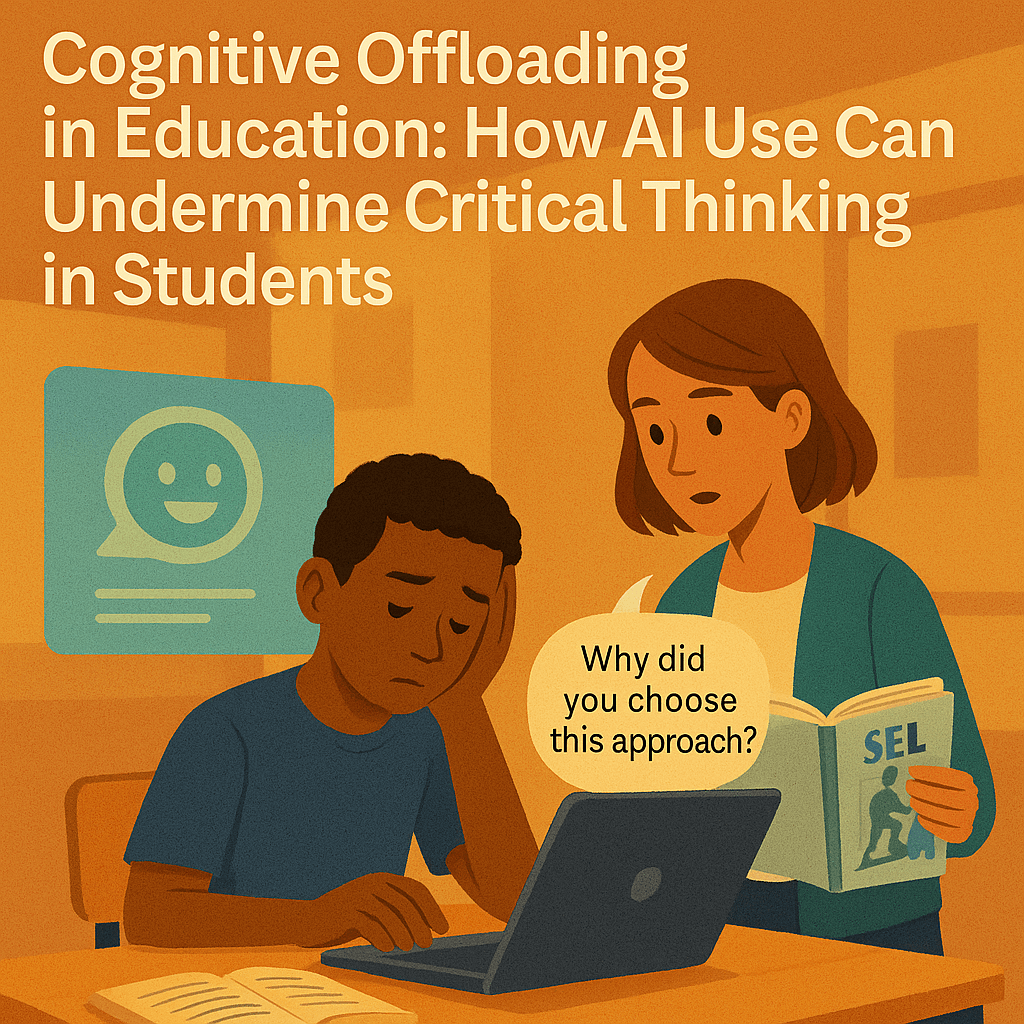
As students increasingly rely on AI to ideate, summarize, or problem-solve, they may be skipping the mental effort required to truly learn. Left unaddressed, this could lead to a generation of learners who can produce answers—but struggle to think deeply, question critically, or reflect meaningfully.
This is the growing challenge of AI and critical thinking in students, and it deserves urgent attention.
What Is Cognitive Offloading in Education?
Cognitive offloading is the act of using external tools to reduce the demands on our brain. Examples include:
Writing to-do lists instead of memorizing them,
Using GPS instead of recalling routes,
Relying on spellcheck instead of internalizing spelling rules.
In moderation, offloading helps manage complexity. But when overused—especially in learning—it can:
Dull problem-solving abilities,
Short-circuit curiosity,
Create dependence on tools instead of strategies.
As Microsoft and Carnegie Mellon’s 2023 study revealed, AI-supported users performed worse on tasks that required analysis, reflection, or nuanced judgment. When AI made the thinking “easier,” the depth of thinking declined.
What does cognitive offloading in education look like in schools
Students using AI to:
Write essays,
Analyze data,
Translate readings,
Generate ideas for projects…
…may finish tasks faster, but report that they “didn’t really learn anything.”
Teachers are noticing:
Superficial answers that lack voice or insight,
Students unable to explain or defend work,
Decreased persistence when challenges arise.
This is cognitive offloading in education at scale—productivity without depth.
The Risk: Polished Outputs, Hollow Understanding
AI can simulate competence. It can produce well-structured writing, solve math problems, and offer “insightful” explanations. But if students:
Don’t wrestle with the content,
Don’t make decisions about what to say and why,
Don’t reflect on what they’ve learned,
…then the result is apparent success without actual growth.
As the Anthropic 2024 study on AI in higher education warned, heavy AI use may discourage independent analysis and increase over-reliance on machine logic—especially among younger learners still developing cognitive stamina.
Why It Matters Now
Education is not just about task completion. It’s about:
Thinking critically,
Arguing with evidence,
Making connections,
Learning how to learn.
AI may help students do, but it can hinder their ability to think—unless we deliberately intervene.
What Schools Can Do to Prevent AI-Induced Complacency
✅ 1. Teach Metacognition
Help students become aware of their thinking. Encourage them to ask:
What did I learn from this?
What decisions did I make during the task?
How did AI influence or change my ideas?
Use reflection prompts or “thinking journals” to capture this process.
✅ 2. Make Process Visible
Require students to document:
What they prompted AI to do,
What outputs they used or rejected,
Why they made certain choices.
This turns AI from a shortcut into a thinking partner.
✅ 3. Assign Explain-Back Tasks
Ask students to explain their reasoning aloud, in writing, or through peer feedback. If they can’t articulate the why, they may not fully understand the what.
✅ 4. Balance AI Use With Manual Practice
Don’t ban AI—but don’t rely on it for every task. Design moments where students:
Brainstorm without AI,
Solve problems on paper,
Write before revising with AI.
This protects core thinking muscles while still building digital fluency.
Benefits of Addressing Cognitive Offloading in Education
✅ Preserves critical thinking and reasoning
✅ Encourages persistence and intellectual grit
✅ Teaches students to use AI intentionally, not habitually
✅ Builds learner confidence and independence
✅ Aligns with future-ready skills and responsible tech use
Pitfalls to Avoid
🚫 Ignoring the impact of AI on student motivation
🚫 Assuming that strong AI outputs reflect strong student understanding
🚫 Over-rewarding polished products without assessing thought process
🚫 Failing to talk openly about when and how to use AI appropriately
Conclusion: Thinking Is Still the Goal
AI can be an incredible learning tool. But it is just that—a tool. When it becomes the primary driver of student work, learning can become passive, shallow, and disengaged.
The challenge for educators is to reclaim thinking as the goal of every assignment, not just completion. That means creating space for struggle, ambiguity, and intellectual discovery.
If we want students to thrive in a world of smart machines, we must help them stay smarter—more reflective, more curious, and more human.
In the end, the question isn’t whether students can use AI. It’s whether they can still think clearly when they do. For more information, visit www.myibsource.com