Table of Contents
Why AI Literacy Matters for Middle School
AI Literacy for Middle School Students: Teaching Responsible and Critical Use of Artificial Intelligence
Artificial Intelligence (AI) is no longer a futuristic idea — it’s a reality shaping how young people live, learn, and interact every day. Middle school students encounter AI constantly, often without realizing it. Every time YouTube recommends a video, Snapchat applies a filter, or a voice assistant like Alexa answers a question, AI is working behind the scenes.
For students ages 11–14, these tools can feel seamless and even magical. Yet without guidance, they may assume AI “thinks” or “feels” like a person, or they may trust it blindly without questioning accuracy or bias. That’s where AI literacy becomes essential. At this age, students are curious, capable of abstract reasoning, and beginning to form their own beliefs about technology. Teaching them how AI works — and doesn’t work — lays the groundwork for lifelong digital responsibility.
What Is AI Literacy?
AI literacy is the ability to understand, question, and responsibly interact with artificial intelligence systems. For middle schoolers, this doesn’t mean mastering coding or building algorithms. Instead, it’s about:
Recognizing AI in everyday life — from gaming to social media.
Understanding how AI learns — by processing patterns in large datasets.
Identifying limitations and risks — such as bias, errors, or lack of empathy.
Practicing digital safety — knowing when to question results and seek adult help.
Building critical thinking — asking, “Who created this AI? With what data? For what purpose?”
At its core, AI literacy blends technical awareness with social-emotional learning (SEL). Students don’t just learn how systems function; they also explore how AI impacts relationships, identity, and decision-making.
The Five Pillars of AI Literacy for Middle School
1. Foundations of AI
The first step is demystifying what AI actually is. Many students think of robots from movies or apps that “talk back” as signs that machines are alive. Teachers and parents can emphasize:
AI is not alive — it doesn’t have thoughts or feelings.
It works by spotting patterns in data, not by understanding meaning.
Humans design and train AI with instructions and examples.
Activities like creating simple “if-then” rules (“If it’s raining, then bring an umbrella”) help students simulate how AI follows logic without emotions.
2. Smart, But Not Human
Students need to understand that while AI can mimic human-like responses, it lacks genuine empathy, creativity, or awareness. For instance, a chatbot might say “I’m here for you,” but it doesn’t actually care. Discussing the difference between machine responses and human connection reinforces why real friends, family, and teachers remain irreplaceable sources of support.
This pillar also connects to digital safety: trusting AI too much can lead to disappointment, misinformation, or even unsafe interactions.
3. Patterns, Data, and Bias
AI systems make predictions by analyzing patterns in data. But if the data is limited, unbalanced, or biased, the results will reflect those flaws. Middle school is the right age to introduce the concept of algorithmic bias.
For example:
A music app may repeatedly recommend the same genre, limiting exposure to diversity.
A search engine might prioritize certain results because of popularity, not accuracy.
A facial recognition tool may misidentify people of certain ethnicities more often than others due to biased training data.
By exploring these examples, students learn that AI is not neutral — it reflects human choices about data.
4. Everyday Uses of AI
AI isn’t just in the background; it shapes how students interact with the world. Practical examples include:
Education — adaptive learning apps that adjust to student progress.
Entertainment — video recommendations, music playlists, and game difficulty levels.
Navigation — GPS apps rerouting based on traffic.
Healthcare — AI tools that assist with diagnostics.
Discussing these uses highlights both the convenience and the responsibility of interacting with AI systems wisely.
5. Safety and Responsibility
Perhaps the most important pillar is teaching middle schoolers how to stay safe. AI tools are powerful, but they should never replace human judgment. Students should learn to:
Question advice from AI before acting on it.
Avoid sharing personal information with chatbots or apps.
Recognize when to ask a trusted adult for guidance.
Understand that AI predictions are based on data, not feelings or moral values.
These skills equip them to navigate the digital world with confidence and caution.
How to Teach AI Literacy in Middle School
Make It Interactive
Middle school students learn best through activities that are hands-on and engaging. Examples include:
Sorting objects with simple rules to model how AI classifies data.
Debating whether an app uses AI or not.
Predicting what content an algorithm might recommend based on user history.
Connect to Their World
Frame AI concepts around what students already use. If they play video games, talk about how enemies “get smarter.” If they watch TikTok, discuss how videos appear in their feed. Relating AI to their experiences makes lessons meaningful.
Integrate SEL Skills
AI literacy is not just technical. Role-playing activities can highlight the difference between AI responses and genuine empathy. Reflection questions like, “What can you do that AI can’t?” encourage self-awareness and ethical thinking.
Use Stories and Scenarios
Stories about bias, digital mistakes, or positive AI applications help students imagine real-world consequences. For example:
“What happens if a self-driving car misreads data?”
“What if AI recommends a harmful video to a younger child?”
“How could AI help doctors save lives?”
Scenarios like these build critical thinking and decision-making skills.
The Benefits of AI Literacy for Adolescents
By teaching AI literacy in middle school, educators and parents can:
Prepare students for future careers — even non-technical jobs will require AI awareness.
Reduce misinformation — helping teens evaluate online content with skepticism.
Encourage responsible use — giving them tools to stay safe with technology.
Foster empathy and ethics — ensuring they see AI as a tool, not a replacement for human connection.
Promote digital citizenship — guiding them to be thoughtful participants in an AI-driven world.
Overcoming Challenges
Some educators worry that AI is too complex for middle schoolers. The key is simplifying without oversimplifying. By focusing on everyday examples, logical rules, and reflection questions, AI becomes accessible. Teachers don’t need to be technology experts; their role is to facilitate curiosity and guide discussion.
Another challenge is ensuring equity. Not all students have equal access to technology at home. Classroom activities should avoid assuming prior experience with certain apps or devices. Instead, focus on universal concepts — patterns, rules, fairness, and safety.
Looking Ahead
AI will only grow more powerful in the years ahead. By the time today’s middle schoolers enter the workforce, they will interact with AI daily in ways we can’t yet predict. Preparing them now ensures they will approach those tools with knowledge, skepticism, and confidence.
Ultimately, AI literacy is about more than technology. It’s about helping young people:
Understand the digital world shaping their identities.
Make responsible, ethical decisions.
Value human connection in an age of machines.
If middle schoolers can learn to see AI clearly — as powerful but not human, helpful but not perfect — they’ll be better equipped to thrive in a future where digital literacy is as important as reading and math.
Final Thoughts
AI Literacy for Middle School Students: Teaching Responsible and Critical Use of Artificial Intelligence
Teaching AI literacy to middle school students is not just a trend — it’s a necessity. At ages 11–14, learners are forming the habits, beliefs, and critical thinking skills that will shape their digital lives. By emphasizing the foundations of AI, its differences from humans, the risks of bias, its practical uses, and the importance of safety, educators and parents can empower students to be thoughtful, ethical, and responsible digital citizens.
AI is here to stay. The question is: will our students be passive users, or informed thinkers who understand the technology shaping their world? Find out more at www.seltrove.com
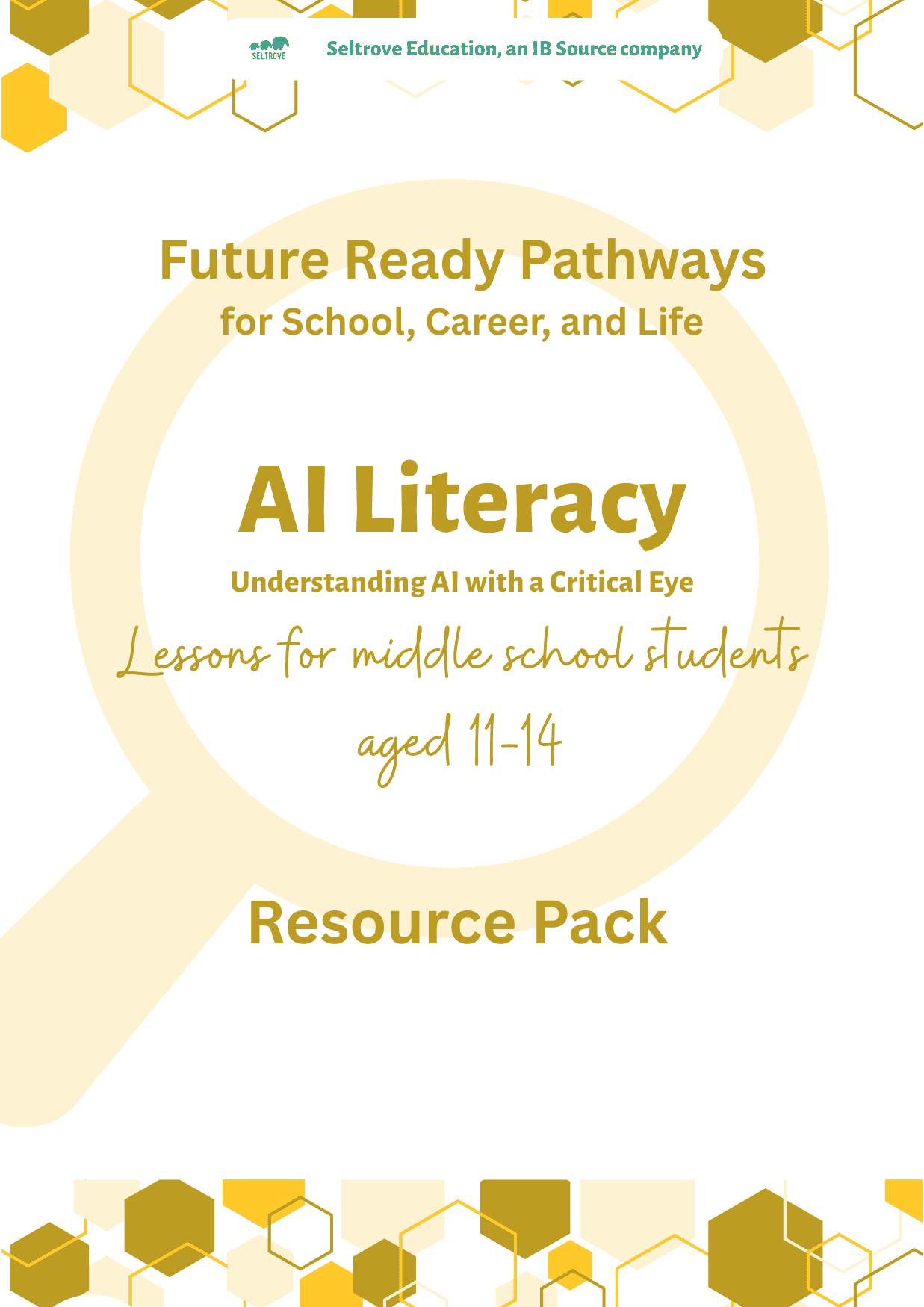
AI Literacy – Understanding AI with a Critical Eye (Middle School) Teacher Resource Pack
$79.00
Downloadable & Printable Resource Pack for Teachers, Homeschools, and Parents Give your students the tools to explore artificial intelligence with curiosity and responsibility.Designed for middle school learners (ages 11–14), this ready-to-use pack helps students understand what AI is, how it… read more