
Table of Contents
Deep Dive IBDP Physics: - D.4 Induction Teacher Resource Pack
Electromagnetic induction lies at the heart of modern technology—from generators and transformers to electric motors and magnetic braking systems. Within the IBDP Physics curriculum (Topic D.4: Electromagnetic Induction), understanding this phenomenon is not just a requirement—it's a gateway to the real-world applications of physics.
To bring this concept to life in the classroom, we’re spotlighting two dynamic, student-tested resources:
Induced EMF in a Coil with Variable Speed
Building an Electromagnetic Induction Motor
These practical activities allow students to explore Faraday’s Law, Lenz’s Law, and the Lorentz force in an engaging, inquiry-based format that promotes critical thinking and data analysis.
⚡ Induced EMF in a Coil with Variable Speed
Curriculum Link: Topic D.4 – Electromagnetic Induction | Faraday’s Law | Lenz’s Law
This activity is a deep dive into how a changing magnetic field induces an electromotive force (emf) in a rectangular coil. Students get hands-on with experimental apparatus and manipulate variables like field strength, coil area, and number of turns to explore their impact on the induced emf. It’s a powerful way to visualize and apply Faraday’s Law of Induction.
Key Learning Objectives:
Investigate how rate of magnetic field change (dB/dt) affects induced emf
Apply
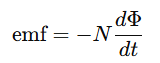
Explore the role of coil area (A) and number of turns (N)
Use Lenz’s Law to determine the direction of induced current
What Students Do:
Connect a coil to a voltmeter and vary the magnetic field using a power supply
Record emf at different field change rates
Change the coil’s area and number of turns
Plot graphs and compare experimental vs. theoretical values
Classroom Benefits:
Emphasizes experimental design and controlled variable testing
Encourages graphical analysis and modeling
Directly supports Internal Assessment (IA) opportunities
Extension Opportunities:
Use AC magnetic fields to explore sinusoidal emf behavior
Try different coil geometries (circular, square) and analyze differences
Add sensors to collect digital data over time
Building an Electromagnetic Induction Motor
Curriculum Link: Topic D.4 – Induced Currents | Motors and Generators | Lorentz Force
This activity invites students to build and test a working electromagnetic motor using basic classroom materials. Through trial, measurement, and analysis, they discover how electric currents, magnetic fields, and motion are interlinked—and how torque is generated by the Lorentz force in a looped conductor.
Key Learning Objectives:
Construct a simple electromagnetic motor
Understand the motor principle:

Analyze how current, magnetic field strength, and coil structure influence rotational speed
Calculate induced emf and motor force
Activity Overview:
Wind a coil and suspend it in a magnetic field
Apply current using a power source
Observe and record rotational behavior
Change the number of turns, current, or field strength, and record results
Discuss energy transformation from electrical to mechanical
What Makes It Effective:
Gives students a real-world context for electromagnetic theory
Builds problem-solving skills around motion, torque, and back emf
Supports extension into efficiency calculations and motor design
Practical Extensions:
Compare motor performance with different coil sizes and materials
Investigate the effects of rotating magnetic fields (AC motor models)
Use the setup to explore generator principles by reversing current direction.
🎓 Why These Resources Belong in Every IBDP Physics Classroom
✔ Deep Alignment with IB Learning Outcomes
Both resources fulfill key expectations in Topic D.4, empowering students to:
Derive and apply Faraday’s and Lenz’s laws
Model and measure real-time variable changes
Understand the mathematical relationship between changing flux and emf
✔ Designed for Hands-On Engagement
Students aren’t just reading about induced currents—they’re:
Measuring them
Graphing them
Building devices that rely on them
This multi-sensory approach promotes durable understanding and sharpens analytical thinking.
✔ IA-Ready Structure
With clearly manipulable variables, well-defined procedures, and measurable outputs, these experiments are ideal springboards for Internal Assessments. For example:
How does coil geometry affect induced emf?
How does increasing magnetic field strength impact torque in a motor?
⚙️ Power Up Your Physics Classroom
Electromagnetic induction is more than a chapter in a textbook—it’s the force behind countless technologies, from headphones to hybrid cars. These two comprehensive, curriculum-aligned resources turn theoretical learning into experimental excitement.
Your students will:
Build confidence with abstract concepts
Experience the wonder of turning current into motion
Develop lab skills and conceptual clarity that serve them well in assessments—and life
👉 Make these resources part of your IBDP Physics toolkit today and help your students harness the power of electromagnetism.