
Table of Contents
Deep Dive IBDP Physics: - C.3 Wave Phenomena Teacher Resource Pack
Understanding waves is foundational in the IBDP Physics curriculum. Whether it’s sound, water, or mechanical oscillations, waves help students conceptualize how energy travels across space and through different media. But these concepts can often feel abstract—especially when learners can’t visualize or hear the differences.
That’s where your classroom comes in.
We’re excited to present two immersive, hands-on resources designed to demystify wave motion and help students master essential learning outcomes from IBDP Topic C.2 – The Wave Model:
Investigating the Doppler Effect in Sound Waves
Examining Wave Speed in Different Media
These experiments combine scientific inquiry with real-world relevance, offering students the chance to explore and calculate wave behaviors in tangible, observable ways.
🎧 Investigating the Doppler Effect in Sound Waves
Curriculum Connection: Topic C.2 – The Wave Model | Frequency, Velocity, Relative Motion
This dynamic lab introduces students to the Doppler effect—the change in frequency observed when the source or observer is in motion. Using sound waves, students explore how this principle explains the redshift of galaxies, the chirp of a siren, and the readings from a Doppler radar.
Learning Objectives:
Understand and calculate frequency shifts caused by motion
Observe the Doppler effect using sound waves and a moving source
Apply the Doppler effect equation to predict observed frequencies
Compare theoretical and experimental values
Activity Overview:
Use a portable speaker to emit a constant tone (e.g., from a tone generator app)
Measure how the frequency changes when either the observer or source moves
Apply the standard Doppler equation:
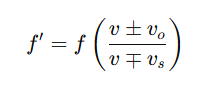
- where:
= observed frequency
= source frequency
= speed of sound in air
and = velocities of observer and source
Why Educators Love It:
Makes the invisible effects of wave motion audible and measurable
Helps students develop graphing, measurement, and error analysis skills
Leads naturally to discussions of real-world applications, from medical ultrasound to astronomical redshift
Suggested Extensions:
Explore light waves and redshift/blueshift in space
Investigate Doppler radar used in weather tracking
Analyze sound wave behavior in varied air densities or mediums
Examining Wave Speed in Different Media
Curriculum Connection: Topic C.2 – Mechanical Waves | Medium Properties | Wave Equations
This practical investigation lets students explore how wave speed changes depending on the medium—be it string, spring, or water. Through direct observation and measurement, learners calculate and compare wave speeds, deepening their understanding of wave mechanics and the physical properties of different materials.
Learning Objectives:
Understand how tension, density, and elasticity affect wave speed
Calculate wave speed using and
Compare wave speeds in strings, ropes, and water
Analyze differences between theoretical and measured values
Activity Highlights:
Use varied media: stretchy bands, strings, springs, and water
Measure wave travel distance and time to calculate velocity
Use wave speed formulae:
Graph wave speed vs. medium type for data analysis
Real-World Applications Discussed:
Seismic wave analysis (earthquake modeling)
Acoustic engineering (designing buildings or instruments)
Material science (understanding mechanical properties)
Why This Resource Works:
Provides hands-on reinforcement of abstract wave theory
Strengthens IBDP-required graphing and calculation skills
Adaptable for varied class sizes and setups (even without water tanks)
Questions to Explore:
How does wave speed vary in different string materials?
Why does wave speed increase with tension and decrease with density?
What makes water wave speeds unique compared to waves on solids?
Why These Wave Model Activities Are Essential for IB Physics
✔ Curriculum-Aligned and Student-Centered
Both activities directly address Topic C.2 – The Wave Model in the IBDP Physics syllabus. Students move beyond theory to:
Visualize and measure wave motion
Calculate and interpret wave speed and frequency
Connect motion to graphical and numerical analysis
✔ Perfect for Internal Assessment (IA) and Beyond
Each experiment offers potential variables and rich data—perfect for developing Internal Assessment projects:
How does frequency change with speed?
What factors most affect wave velocity?
How accurate are our theoretical models compared to real-world results?
✔ Tied to the Real World
Physics becomes more meaningful when students see how it applies:
Doppler radar and speed traps
Redshift in astronomy and expanding universe models
Earthquake waves and material testing in civil engineering
These connections show students that waves aren’t just a topic on an exam—they’re part of the technology, medicine, and science that shape our lives.
🚀 Transform Your Wave Unit with Hands-On Science
These two resources will help your students feel, hear, and measure the science of wave behavior. With approachable setups and deep curriculum alignment, they’ll turn your wave model lessons from theoretical to unforgettable.
Whether you’re reviewing fundamentals or laying the groundwork for a top-scoring IA, these labs make wave physics accessible and exciting.
👉 Add these resources to your IBDP Physics toolkit today and bring sound, motion, and meaning to every wave lesson.