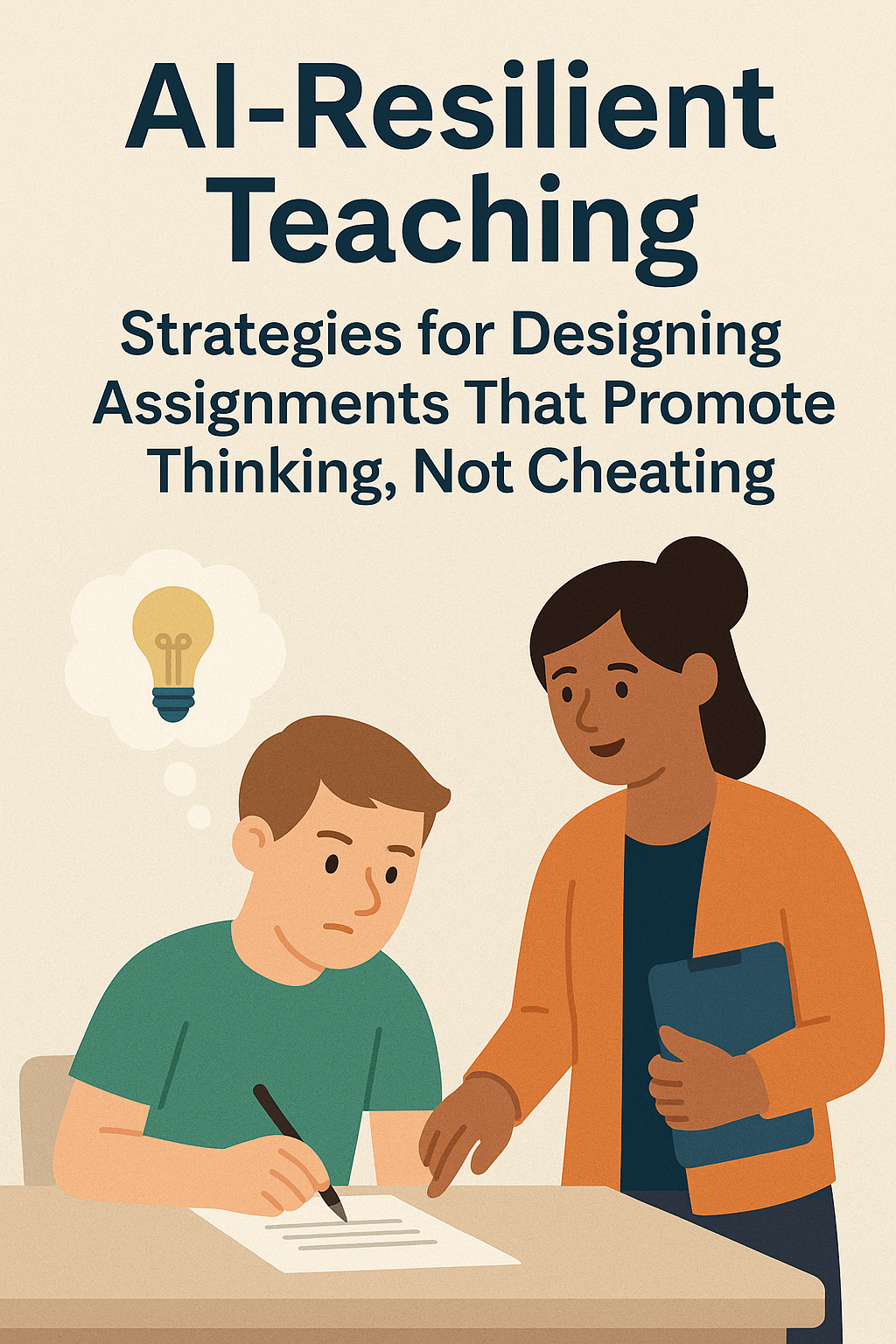
AI-Resilient Teaching: Strategies for Designing Assignments That Promote Thinking, Not Cheating -The rise of generative AI has sparked a wave of anxiety across schools: How do we stop students from cheating with AI?
But framing the challenge purely in terms of prevention misses the bigger opportunity. Rather than trying to AI-proof lessons, educators should be asking a more powerful question:
How can we design learning that’s worth doing—even in the age of AI?
This is the heart of AI-resilient teaching strategies: not about banning tools, but about designing assignments that promote deep thinking, creativity, reflection, and connection.
The Problem with “AI-Proofing”
The instinct to shut AI out is understandable. But approaches like banning devices, reverting to handwritten assignments, or using surveillance software often:
Undermine student trust,
Penalize neurodivergent and multilingual learners,
Ignore real-world digital realities,
Shift focus from learning to compliance.
These strategies treat AI as the enemy, rather than as a reality to be understood and managed.
Instead, we need assignments that retain their educational value even when AI is present—because they ask students to do the things AI can’t do well: reflect, explain, relate, empathize, and apply.
Core Principles of AI-Resilient Teaching
To build truly resilient learning experiences, focus on assignments that are:
🧠 1. Process-Oriented
Make thinking visible. Ask for outlines, drafts, annotated planning, revision steps, and reflections. If students use AI, have them document how they used it and what they changed.
💬 2. Dialogic and Iterative
Structure tasks that involve discussion, peer feedback, or revision over time. AI can’t replicate the nuance of human dialogue and evolving understanding.
🎭 3. Personalized and Contextualized
Ask students to connect learning to their own lives, communities, or current events. The more specific the context, the harder it is for AI to generate a meaningful, relevant response.
🧾 4. Reflective and Meta-Cognitive
Build in questions like:
What surprised you?
What was challenging?
How did your thinking evolve? These prompts are hard for AI to fake—and deepen student awareness.
🔍 5. Multi-Modal
Encourage presentations, podcasts, infographics, sketchnotes, or performance tasks. Moving beyond text limits the usefulness of text-based AI tools and empowers diverse learners.
Assignment Ideas That Encourage Thinking, Not Cheating
Case Study + Reflection: Have students analyze a real-world scenario, then reflect on how their personal values influenced their conclusions.
AI Dialogue Analysis: Ask students to generate a response using AI, then critique it, improve it, and explain their changes.
Project Journals: For long-term projects, require students to keep a process log, capturing challenges, iterations, and shifts in understanding.
Peer-Led Discussions: Let students facilitate or co-design classroom debates based on AI-supported research—emphasizing curation and synthesis.
Digital Ethics Portfolios: Students build and reflect on a portfolio of interactions with AI, documenting what they learned about bias, language, and authorship.
What the Research Says
The Brookings Institution and Edutopia both advocate for assignments that prioritize student voice and original reasoning over AI-defensible correctness.
Educators are finding that AI-resilient assignments are not just about protecting integrity—they’re about deepening learning.
Benefits of AI-Resilient Teaching Strategies
✅ Reinforces academic honesty without fear-based policies
✅ Builds transferable thinking and digital literacy skills
✅ Encourages creativity, authenticity, and student agency
✅ Prepares students for real-world collaboration with AI
✅ Shifts focus from “getting it done” to “making meaning”
Pitfalls to Avoid
🚫 Ignoring AI’s presence altogether
🚫 Designing work that rewards surface-level completion
🚫 Assuming all students understand how to reflect on AI use
🚫 Equating AI use with dishonesty rather than teachable moments
Resilient teaching doesn’t mean eliminating AI—it means elevating learning beyond what AI can do alone.
Conclusion: From Surveillance to Substance
In an AI-rich world, the most powerful thing teachers can do is return to what has always mattered most: thinking, creativity, and connection. The article AI-Resilient Teaching: Strategies for Designing Assignments That Promote Thinking, Not Cheating is much needed.
By designing assignments that challenge students to reflect, synthesize, and grow, educators can reclaim learning as a deeply human act—one that thrives with AI as a tool, but not a substitute.
Designing assignments in the age of AI isn’t about blocking the machine. It’s about empowering the mind. Find out more at www.myibsource.com