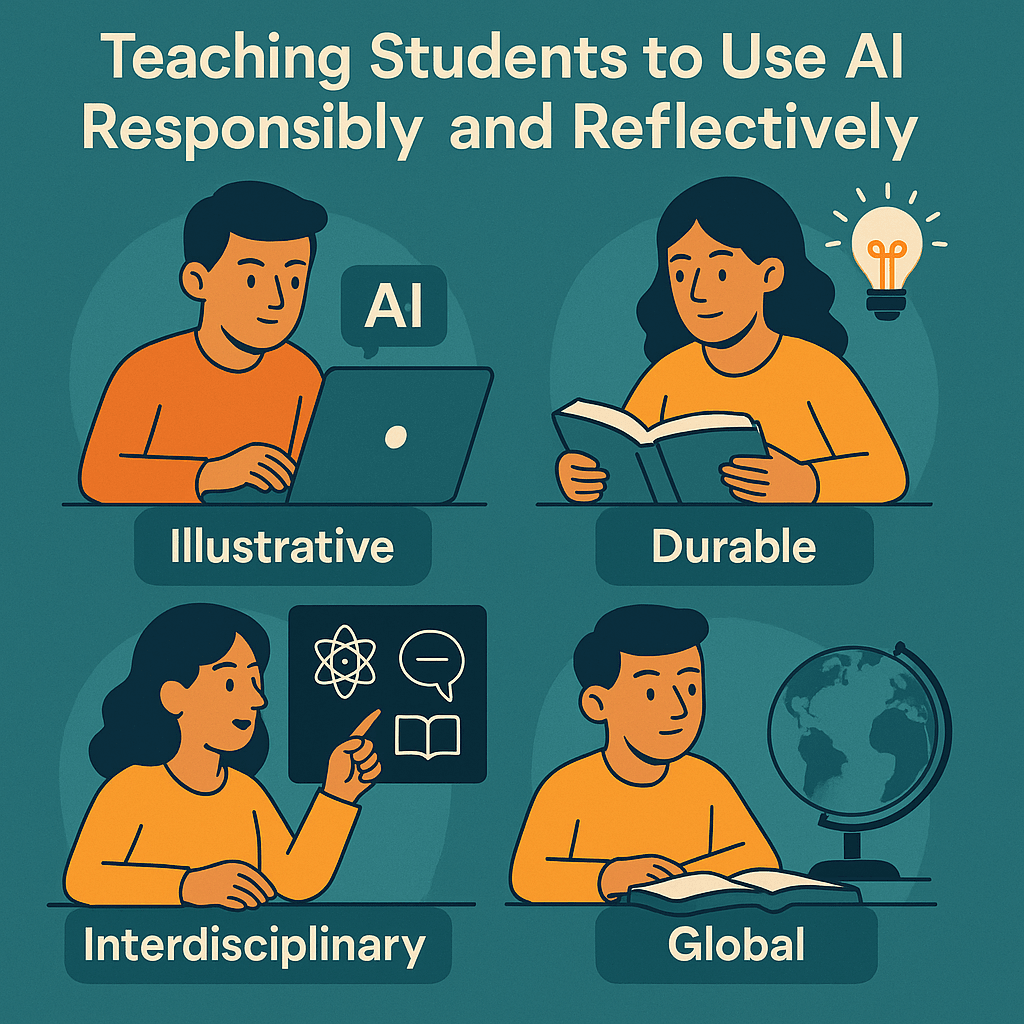
AI literacy in schoolsTeaching Students to Use AI Responsibly and Reflectively - As generative AI tools become more common in classrooms, a critical gap is emerging—not in access, but in understanding. Students are learning how to generate impressive essays, solve complex problems, and even simulate arguments using AI. But few are being taught to think about how those tools work, what ethical lines exist, or how to use them as thinking partners rather than shortcuts.
This is where AI literacy in schools must evolve: from teaching how to use AI tools, to exploring why and when to use them—and just as importantly, when not to.
The Shift: From Passive Users to Critical Thinkers
Students today are digital natives, but that doesn’t automatically make them AI-literate. Teaching them to enter a prompt and receive an answer is just the start. What’s needed is a deeper, more reflective approach that emphasizes:
Prompt design as a form of thinking, not just task-giving.
Metacognition, where students reflect on how AI shaped their output.
Discernment, to evaluate the quality and source of AI-generated content.
Ethical boundaries, like transparency, bias, and academic integrity.
This is the future of responsible use of AI by students—and it must be deliberately cultivated so that Teaching Students to Use AI Responsibly and Reflectively works effectively
Why Prompting Is Cognitive Work
Prompting isn't about typing “Write a summary of Hamlet.” It's about framing a question, anticipating an output, and refining your request when the results miss the mark.
In this way, prompting becomes a form of critical thinking and iteration—if, and only if, students are taught to treat it that way. When students understand the role of prompting in shaping AI output, they begin to see themselves not just as users, but as designers of learning experiences.
The Reflection Gap: Are Students Thinking Less?
A growing concern among educators and researchers is that students are bypassing the thinking process entirely. According to a recent Microsoft and Carnegie Mellon study, AI use in knowledge work environments can reduce critical thinking performance when individuals lean too heavily on it for analysis or decision-making.
This is echoed in anecdotal reports from classrooms: students feel like they’re learning less, not more, when they rely on AI to generate answers. If students aren't reflecting on what AI is doing for them—or to their thinking—they risk outsourcing their learning entirely.
Building AI Literacy: What Schools Can Do
To promote AI literacy in schools, educators should embed three key practices into their curriculum:
🧠 1. Reflective Annotation
After using an AI tool to support a task, students should annotate what the AI did, what they learned, and what they changed. This builds metacognitive awareness.
Example: “I used ChatGPT to generate a draft outline. I kept the main structure, but replaced the examples because they didn’t fit my topic.”
💬 2. Prompt Journaling
Students keep a log of the prompts they try, what worked, what failed, and how they adjusted. This encourages iterative problem-solving and transparency.
⚖️ 3. Ethical Use Declarations
Require students to submit an “AI use statement” with every assignment. They must disclose if and how AI was used and reflect on its impact on their thinking. This builds accountability and academic integrity.
Benefits of This Approach
Fosters a deeper understanding of AI’s strengths and limitations.
Encourages students to become more discerning consumers of digital content.
Prepares students for future workplaces where AI tools are ubiquitous, but critical thinking remains a premium skill.
Reinforces responsible digital citizenship, aligned with ISTE standards and frameworks from Common Sense Education (AI Literacy Resources).
Pitfalls to Avoid
Over-policing: Treating AI use as inherently dishonest may backfire. Focus on responsible use, not zero tolerance.
Under-teaching: Ignoring GenAI tools in the classroom won’t stop students from using them—just from using them well.
One-size-fits-all policies: Schools need flexible frameworks that distinguish between using AI to support learning and using AI to replace it.
As noted in the Brookings Institution’s pre-mortem on AI in education, failure to define these boundaries now risks letting AI adoption drift into ethically ambiguous territory.
Conclusion: Teaching with AI, Not Around It
The goal isn’t to ban AI tools—it’s to teach students to use them with intention. A student who knows how to prompt reflectively, analyze outputs critically, and disclose AI use transparently isn’t just learning how to use technology. They’re learning how to think. Teaching Students to Use AI Responsibly and Reflectively
That’s what AI literacy in schools must mean in this era—not just knowing how to use the tool, but knowing how to learn with it. Find out more at www.myibsource.com