
Table of Contents
- Deep Dive IBDP Physics: - D.3 Motion in Electromagnetic Fields Teacher Resource Pack
- ⚡ Visualization of the Electric and Magnetic Forces on a Charged Particle
- 🧲 Cyclotron Motion and Charge-to-Mass Ratio
- Curriculum Integration and Assessment Readiness
- 🔎 Recommended Shopify SEO Tags
- 🚀 Help Students Visualize and Master Electromagnetic Forces
Deep Dive IBDP Physics: - D.3 Motion in Electromagnetic Fields Teacher Resource Pack
In the IBDP Physics curriculum, understanding how charged particles interact with electric and magnetic fields is a cornerstone of topics like Fields and Forces, Electromagnetism, and Motion in Electromagnetic Fields. These concepts not only form the basis of theoretical physics but also underpin technologies like mass spectrometry, cathode ray tubes, and particle accelerators.
To bring these high-impact principles to life in your classroom, we’re excited to showcase two exceptional resources:
Visualization of the Electric and Magnetic Forces on a Charged Particle
Cyclotron Motion and Charge-to-Mass Ratio
These lab-based investigations give students the opportunity to explore the dynamic interplay between electric and magnetic fields and apply the Lorentz force law in realistic and measurable scenarios.
⚡ Visualization of the Electric and Magnetic Forces on a Charged Particle
Curriculum Link:
Topic 6: Fields and Forces
Topic 3: Electromagnetism
Topic 5: Electromagnetic Induction
This hands-on activity immerses students in the core concepts of electromagnetism, enabling them to observe how a charged particle behaves when subjected to perpendicular electric and magnetic fields. Students apply the Lorentz force law, visualize motion paths, and explore how altering field strengths changes the particle’s trajectory.
Learning Objectives:
Apply the Lorentz force equation:

Use the right-hand rule to determine force directions
Observe the impact of changing electric and magnetic field strengths on particle trajectory
Understand how circular or spiral motion emerges from balanced fields
Classroom Implementation:
Utilize an electron gun or ion source inside a vacuum chamber
Generate uniform electric fields using parallel plates
Produce perpendicular magnetic fields with Helmholtz coils
Record trajectory radius and direction as students adjust the field magnitudes
Encourage students to calculate net force, particle velocity, and path curvature
Why Teachers Love It:
Provides a clear, visual model of abstract vector fields
Offers multiple levels of inquiry, from concept visualization to quantitative analysis
Builds a bridge to more advanced topics like cyclotrons, velocity selectors, and mass spectrometers
Suggested Discussion Prompts:
What happens when electric and magnetic forces balance?
How does the direction of motion change with field polarity?
What real-world technologies rely on this principle?
🧲 Cyclotron Motion and Charge-to-Mass Ratio
Curriculum Link:
Topic D.3: Motion in Electromagnetic Fields
Topic 6: Fields and Forces
Topic 5: Electromagnetic Induction
This advanced resource guides students through calculating the charge-to-mass ratio (e/m) of a charged particle using its motion in a magnetic field—a classic experiment foundational to modern physics. Students engage in problem-solving, data collection, and error analysis to deepen their understanding of the forces that govern circular motion in magnetic fields.
Learning Objectives:
Investigate cyclotron motion and understand why particles follow circular paths
Derive and use the relationship:

Use energy principles to determine particle velocity from potential difference
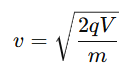
Calculate and analyze the charge-to-mass ratio of electrons or ions
Activity Breakdown:
Create a uniform magnetic field using Helmholtz coils
Inject a charged particle into the field and measure its circular path radius
Record voltage, magnetic field strength, and particle motion
Compare calculated e/m ratio to the known value for an electron
Extend learning with investigations on different particles and field strengths
Why It’s a Must-Have:
Offers a gateway to particle physics and accelerator science
Integrates concepts from both mechanics and electromagnetism
Promotes real lab skills—measurement, graphing, error analysis
Extensions and IA Potential:
Explore different particles and their behavior in identical fields
Test the impact of increasing magnetic strength on orbital radius
Design a velocity selector or prototype mass spectrometer using this foundation
SEO Keywords: charge-to-mass ratio experiment, cyclotron motion physics lab, calculate e/m for electrons, particle motion in magnetic fields, IBDP electromagnetic force lab.
Curriculum Integration and Assessment Readiness
These resources align seamlessly with key elements of the IBDP Physics syllabus and provide ideal opportunities for both Paper 2 practice and Internal Assessment (IA) topics:
Core Topics Covered:
Vector addition of forces
Circular motion principles
Electromagnetic field interactions
Kinetic energy and velocity equations
Experimental method and precision measurements
IB Skills Strengthened:
Data collection and processing
Mathematical derivation and modeling
Graph interpretation and analysis
Critical evaluation of experimental results
IA Relevance:
These labs provide clear, manipulable variables and a direct path to experimental inquiry. Potential IA ideas include:
Investigating the effect of field strength on circular radius
Measuring discrepancies in theoretical vs. experimental e/m values
Comparing charged particle behavior in uniform vs. non-uniform fields
🔎 Recommended Shopify SEO Tags
Optimize your listings to reach IBDP educators with targeted, searchable tags:
Lorentz force student experiment
IBDP electromagnetic field interaction activity
Charge-to-mass ratio classroom lab
Electric and magnetic field motion physics
Particle trajectory and field strength physics lab
Cyclotron motion e/m calculation IBDP
Velocity selector hands-on resource
IBDP physics internal assessment electromagnetism
🚀 Help Students Visualize and Master Electromagnetic Forces
Understanding the behavior of charged particles in electric and magnetic fields is more than an academic exercise—it’s a glimpse into how our world (and the universe) operates. From particle accelerators to electric motors, this is the physics that powers our technology.
With these two in-depth, high-quality resources, you’ll:
Elevate your students’ conceptual grasp of electromagnetic fields
Enable hands-on practice of key formulas and principles
Offer IA-ready material that meets IBDP standards
👉 Add these resources to your IBDP Physics classroom toolkit today, and watch your students bring motion, force, and electromagnetism to life.