Table of Contents
- The IB Diploma History Curriculum 2026: What’s Changing and Why It Matters
- 1. A Shift from “Studying” to “Doing” History
- 2. The New Inquiry-Based Curriculum Model
- 3. Revised Course Structure and Hours
- 4. Updated Content Options
- 5. Assessment Model: Conceptual and Progressive
- 6. Sample Exam Questions Show the Shift
- 7. Comparison to the Previous IB History Curriculum
- 8. What It Means for IB Teachers
- 9. Final Thoughts: A Curriculum for the Future
The IB Diploma History Curriculum 2026: What’s Changing and Why It Matters
IB Diploma History Curriculum 2026
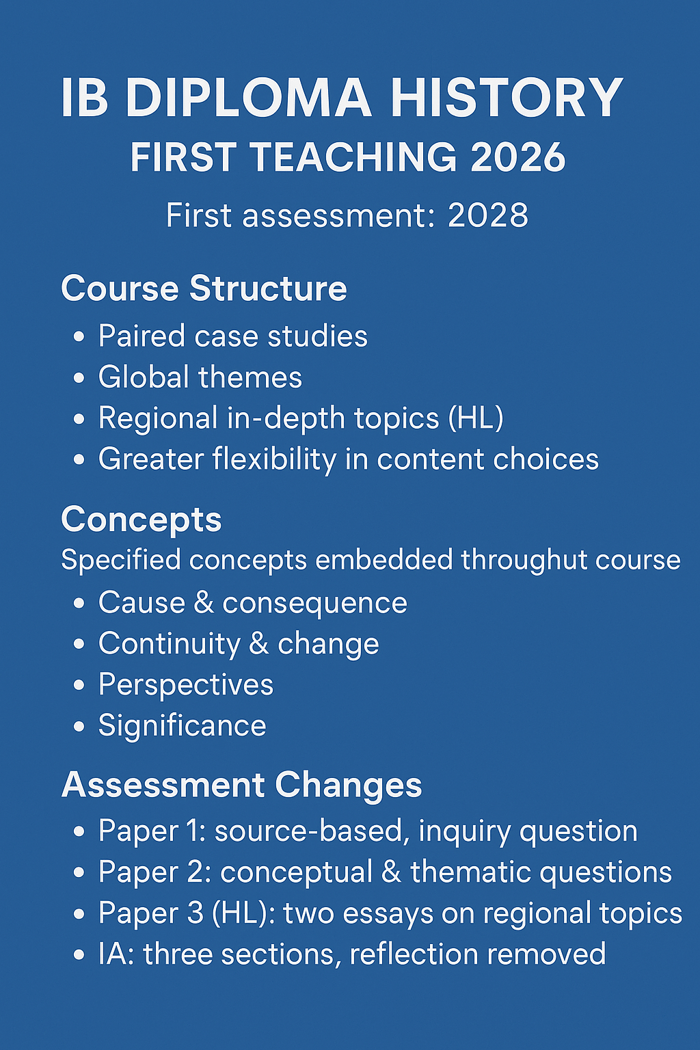
The International Baccalaureate (IB) has unveiled the new IB Diploma History curriculum, set for first assessment in 2028. This curriculum represents one of the most significant updates in years, designed to deepen students’ understanding of the past while empowering them to think — and act — like historians.
The IB Diploma History Curriculum 2026 emphasizes historical inquiry, conceptual thinking, and global awareness. Teachers and coordinators should prepare for a shift away from rote content toward interpretative, skills-based engagement.
1. A Shift from “Studying” to “Doing” History
The updated History course transforms students from passive learners into active investigators. Instead of memorizing names and dates, they’ll analyze evidence, evaluate perspectives, and build their own interpretations of historical events.
This approach builds historical thinking skills and aligns closely with IB’s broader philosophy — fostering inquiry, open-mindedness, and intercultural understanding.
In essence, students are not just learning about history; they are learning how to do history.
2. The New Inquiry-Based Curriculum Model
At the core of the 2026 IB History curriculum lies the Historical Inquiry Model, which integrates four connected elements: Contexts, Concepts, Content, and Skills.
| Element | What It Means | What’s New |
|---|---|---|
| Contexts | Frameworks for study — focused, thematic, regional, and independent investigations. | Replaces rigid topic lists with flexible inquiry areas. |
| Concepts | Key ideas that guide interpretation — cause and consequence, continuity and change, perspectives, and significance. | A streamlined, conceptual framework unifying the course. |
| Content | Teachers choose from a wider global range to fit their classroom context. | Increased autonomy and inclusivity in content selection. |
| Skills | Evaluating sources, constructing arguments, synthesizing perspectives. | Skills are directly taught and assessed across papers. |
This model encourages students to engage critically with evidence and to think like professional historians.
3. Revised Course Structure and Hours
The new structure provides clarity and flexibility for both Standard Level (SL) and Higher Level (HL) students:
SL: 150 teaching hours
Focused Study: 50 hours
Thematic Study: 80 hours
Historical Investigation: 20 hours
HL: 240 teaching hours
Focused Study: 50 hours
Thematic Study: 80 hours
Regional Study: 90 hours
Historical Investigation: 20 hours
This design ensures balanced global coverage while allowing deeper exploration at HL.
4. Updated Content Options
The new IB History syllabus introduces five focused study themes, four thematic pathways, and four regional areas for HL depth.
🔹 Focused Studies (choose one):
Independence and Identity
Political and Economic Transitions
Conflict and Displacement
Climate and Innovation
Protest and Change
🔹 Thematic Studies (choose one):
Conflict (from 750 CE)
Innovation and Transformation (from 750 CE)
Authoritarian Rule (from 1750 CE)
Popular Movements (from 1750 CE)
🔹 Regional Studies (HL only):
Africa & the Middle East
The Americas
Asia & Oceania
Europe
These options reflect a broader, more inclusive global history, allowing schools to design regional learning experiences that resonate with their students.
5. Assessment Model: Conceptual and Progressive
Assessment is now built around six historical inquiry elements:
Inquiry contexts
Concepts
Sources
Content
Arguments
Inquiry questions
Each paper assesses these differently, encouraging cumulative skill development.
SL Assessment (2028 onward)
Paper 1 (30%) — Source-based focused study
Paper 2 (40%) — Thematic analysis and conceptual essays
Internal Assessment (30%) — Individual historical investigation
HL Assessment
Paper 1 (20%) — Source analysis
Paper 2 (25%) — Conceptual and thematic evaluation
Paper 3 (35%) — Two regional essays
Internal Assessment (20%) — Extended inquiry project
This marks a decisive shift toward analytical depth and concept-driven essays.
6. Sample Exam Questions Show the Shift
Examples from the IB’s 2025 subject brief highlight the focus on interpretation and argumentation:
“To what extent was persecution the main reason for post-war mass displacement in Europe?”
“Analyse how historical events can have multiple causes.”
“The Mexican Revolution significantly changed the role of women. To what extent do you agree?”
These questions test students’ ability to use evidence to construct reasoned, evaluative responses — not simply recall facts.
7. Comparison to the Previous IB History Curriculum
| Previous (2017) | New (2026) |
|---|---|
| Prescribed regional topics | Inquiry-based contexts |
| Content-heavy and factual | Conceptual and interpretive |
| Fixed Paper 1 subjects | Flexible Focused Studies |
| Limited conceptual focus | Four core historical concepts |
| Narrow regional focus | Global and comparative approach |
| Descriptive IA | Structured three-part historical investigation |
8. What It Means for IB Teachers
For educators, the new curriculum means:
Greater teaching autonomy and creativity in selecting topics.
Focus on conceptual understanding and skills integration.
Increased opportunities for student voice through inquiry projects.
A stronger connection between global history and local relevance.
9. Final Thoughts: A Curriculum for the Future
IB Diploma History Curriculum 2026
The IB Diploma History Curriculum 2026 reflects the IB’s ongoing commitment to critical thinking, intercultural awareness, and academic rigor.
By teaching students to “do history,” not just memorize it, this new framework prepares learners for university-level research — and for understanding a complex, interconnected world.
Find out more at www.myibsource.com
IB DP History: Climate and Innovation Course Companion

$69.00
Oxford Resources for IB DP History: Climate and Innovation Course Book (2026 Syllabus) Prepare students for success in the International Baccalaureate Diploma Programme (IB DP) History course with Oxford Resources for IB DP History: Climate and Innovation Course Book. This… read more
IB DP History: The Americas Course Companion

$89.00
Oxford Resources for IB DP History: The Americas Course Book (2026 Syllabus) Prepare students for success in the IB Diploma Programme History course with Oxford Resources for IB DP History: The Americas Course Book. This comprehensive and expertly written resource… read more