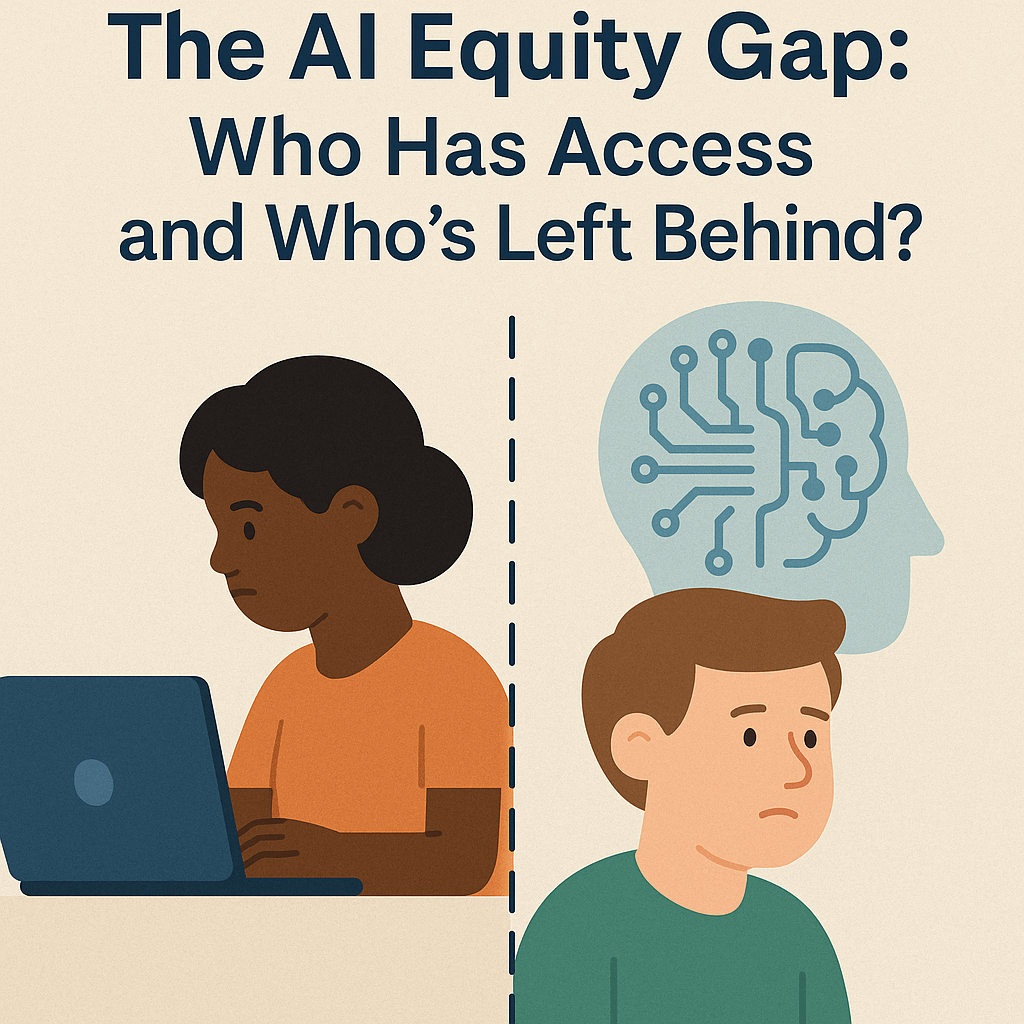
The AI Equity Gap: Who Has Access and Who's Left Behind - The rise of generative AI in schools is often framed as a leap forward—more personalized instruction, faster feedback, and new opportunities for creativity and critical thinking. But as this technology spreads, a critical question looms:
Who gets to benefit?
The promise of AI is not evenly distributed. A growing body of evidence suggests that access to—and meaningful use of—AI in schools is already being shaped by familiar forces: funding gaps, infrastructure inequalities, and systemic bias. This is the AI equity gap in education, and it may be widening the digital divide faster than many realize.
Understanding the AI Equity Gap
While many K–12 students have access to basic digital devices, that doesn't mean they have equitable access to the AI tools transforming learning. Consider:
Not all schools allow AI tools like ChatGPT or Khanmigo.
Many educators lack training on how to use or teach with AI.
High-income schools are more likely to pilot AI tools with support and safeguards.
Students in under-resourced schools may never see AI integrated into learning—at least not intentionally.
As a result, some students are gaining fluency in AI use, ethics, and integration. Others are not even aware that these tools exist.
This divide risks creating what the OECD calls an “AI knowledge gap,” where students from privileged backgrounds develop skills and digital confidence while others fall further behind.
Why This Matters Now
The longer we wait to address equity in AI access, the more we risk reproducing historical injustices—only now with machine learning and automation at the center.
If AI becomes a key feature of education, workforce preparation, and social mobility, then AI fluency becomes a form of power. And when that power is inequitably distributed, technology amplifies—not solves—existing inequalities.
As Digital Promise puts it, AI equity means not just ensuring access to tools, but supporting meaningful engagement with those tools in ways that honor students’ diverse needs and contexts.
Where Inequity Shows Up
💻 Access to Devices and Infrastructure
Students in underfunded schools often face:
Outdated devices that can’t run AI tools effectively,
Inconsistent internet access at school or home,
Limited classroom time for exploratory use of technology.
👩🏫 Teacher Training and Professional Learning
Without robust professional development, teachers may:
Avoid using AI due to uncertainty,
Rely on it in shallow ways,
Miss opportunities to support student voice and agency.
Districts with strong PD pipelines are better positioned to support thoughtful AI integration. Others are left to figure it out alone—or not at all.
📚 Curriculum and Instructional Design
Some schools are embedding AI literacy into the curriculum—teaching ethics, prompt engineering, and critical evaluation. Others still rely on outdated digital literacy frameworks that barely mention AI.
The result? A widening gap in digital readiness for the future.
What Equity-Minded AI Integration Looks Like
To close the gap, schools and districts must center inclusion, access, and student agency at every stage of AI adoption:
✅ Start with Infrastructure
Ensure that devices and internet access are reliable, fast, and compatible with AI tools.
✅ Invest in Teacher Capacity
Offer ongoing professional development that supports not just tool use, but critical pedagogy and culturally responsive instruction.
✅ Design with Student Voice
Co-create AI policies and lessons with diverse student groups to reflect their realities and aspirations.
✅ Align AI with Equity Goals
Use AI to reduce—not widen—achievement gaps. For example, offer AI tutoring in multiple languages, or use it to scaffold complex texts for emerging readers.
✅ Track and Monitor Impact
Collect disaggregated data on AI tool access and outcomes. Ask: Who is using AI? How? Who isn’t? Why not?
Benefits of Equity-First AI Implementation
✅ Bridges opportunity gaps for historically marginalized students
✅ Ensures all students build future-ready skills
✅ Prevents overuse or misuse of AI as a “cheap fix” in underfunded schools
✅ Empowers communities to shape AI's role in education, not just react to it
✅ Builds a more just and inclusive digital society
Pitfalls to Avoid
🚫 Assuming device access = meaningful AI access
🚫 Rolling out AI tools without multilingual, disability-aware, or trauma-informed design
🚫 Treating AI integration as an “extras for honors” initiative
🚫 Over-relying on vendors instead of engaging community needs
Conclusion: Equity is the New Innovation
To conclude the article on The AI Equity Gap: Who Has Access and Who's Left Behind. True innovation in education doesn’t just ask what’s possible—it asks what’s just. As we integrate generative AI into K–12 learning, we must commit to ensuring every student—not just the privileged few—has a chance to engage, learn, and lead with these tools.
Addressing the AI equity gap is not just about closing access—it’s about opening doors to deeper understanding, agency, and participation in the future of learning. Find out more at www.myibsource.com