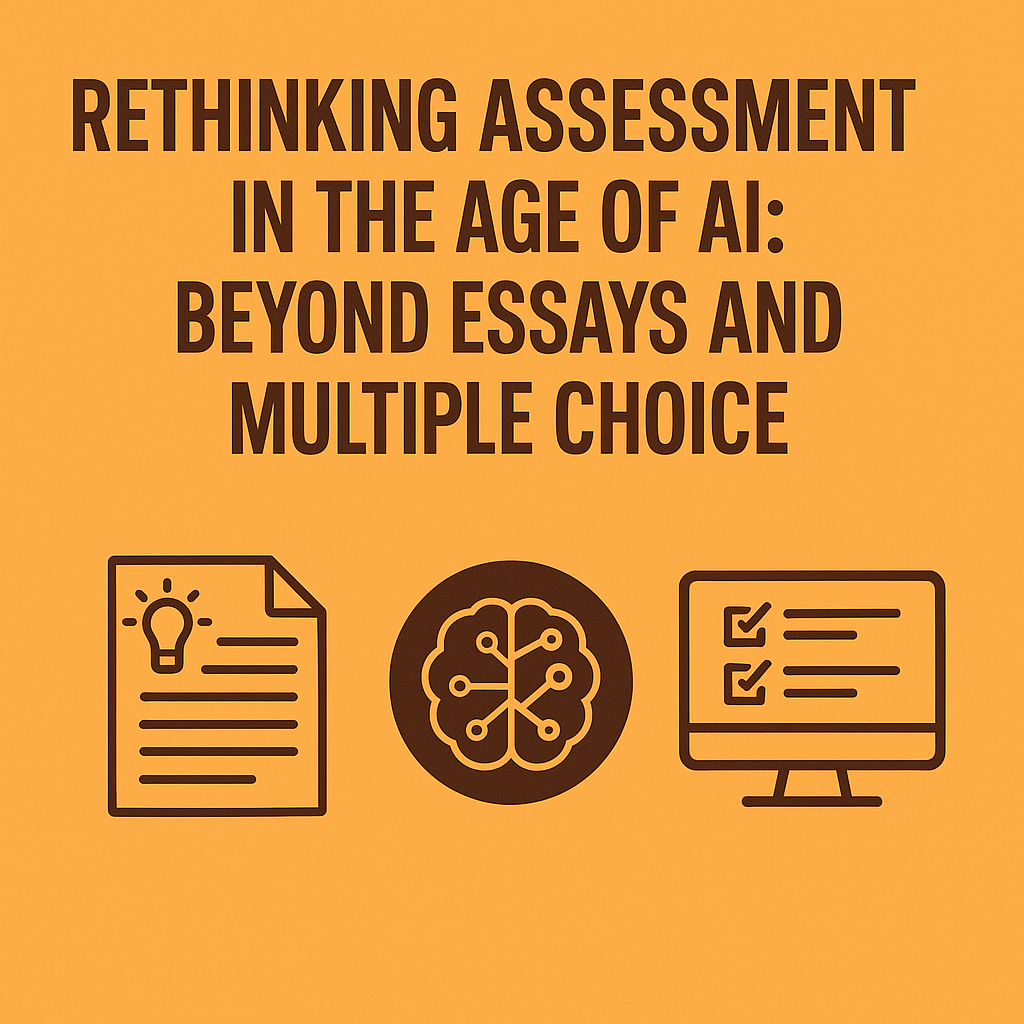
Rethinking Assessment in the Age of AI: Beyond Essays and Multiple Choice - Generative AI tools can now write essays, analyze literature, solve math problems, and even simulate lab experiments—all in seconds. As their capabilities grow, one thing is clear: traditional assessments are facing an identity crisis.
Educators must now ask not just how students perform, but how to assess what they’ve genuinely learned. It’s time to rethink educational evaluation for a world where artificial intelligence is a constant companion—not a classroom novelty.
The Problem with Old Models in a New Era
Traditional assessments—essays, multiple choice tests, coding assignments, and reports—assume a closed loop of student effort and teacher evaluation. But with AI tools like ChatGPT and Copilot available 24/7, that loop is broken.
Students can now produce work that appears polished and original with minimal intellectual effort. In some cases, AI-generated answers are more accurate or better written than what the average student would produce independently. This poses a serious challenge to AI in student assessment.
If teachers can’t confidently verify who—or what—did the thinking, what does it mean to grade “student work”?
The Risk of Overcorrection: Going Backward
Rethinking Assessment in the Age of AI: Beyond Essays and Multiple Choice - Faced with this uncertainty, some schools are reverting to low-tech strategies: handwritten essays, timed in-class tests, oral exams, and worksheet drills.
While these can ensure authenticity, they also risk sacrificing the skills students need most—digital literacy, collaboration, and real-world problem-solving. We can’t prepare students for an AI-rich future by shielding them from it.
The challenge isn’t how to AI-proof assessment. The challenge is how to design AI-integrated assessments that foster deeper learning and authentic understanding.
Principles for Assessment in the Age of AI
To move forward, schools should adopt three guiding principles:
🧠 1. Assess Process, Not Just Product
Learning is more than the final result. Require students to document their steps:
Prompt design (if AI is used),
Rough drafts or code iterations,
Reflections on what AI generated vs. what the student changed.
Example: A student writing an essay with AI support must include screenshots of prompts and outputs, along with commentary on how they edited or critiqued the result.
🧪 2. Embrace Performance-Based and Portfolio Assessment
Shift toward assessments that measure real-world application, creative problem-solving, and collaboration. This might include:
Project-based learning,
Multimedia storytelling,
Simulations or debates,
Peer feedback and revisions.
These formats make it harder to outsource work and easier to evaluate student voice, effort, and originality.
🔍 3. Make Reflection Central
Ask students to reflect explicitly on:
How they approached the task,
What tools (AI or otherwise) they used,
What they learned,
What they’d do differently.
Reflection makes thinking visible—and ensures that students can explain why and how, not just what.
What the Research Says
The Brookings Institution emphasizes that AI isn’t just disrupting assessment—it’s an invitation to rethink what we value in education. Assessment must evolve from a gatekeeper to a growth enabler.
Meanwhile, Edutopia recommends integrating AI into the assessment process itself, encouraging transparency and prompting ethical conversations about digital authorship.
These shifts aren’t just logistical—they’re philosophical. They ask us to center student learning, not just student compliance.
Benefits of AI-Informed Assessment Design
✅ Prepares students for the real world, where AI tools are ubiquitous
✅ Encourages transparency and academic honesty
✅ Fosters deeper learning and metacognition
✅ Increases student agency and creativity
✅ Reduces grading bias by focusing on reflection and process
Pitfalls to Avoid
🚫 Designing one-size-fits-all “no AI” policies
🚫 Assuming AI use = cheating
🚫 Ignoring students' voices in assessment design
🚫 Reverting to outdated assessment types that don't align with 21st-century skills
Instead, invite students to co-construct the boundaries of ethical AI use and clarify when it's appropriate to use tools and how to cite them. Find out more at www.myibsource.com