Table of Contents
The Power of “Why?”
Curiosity in Bloom: How Critical Thinking Begins in Early Learning
If you’ve ever spent time with a kindergartner, you know that curiosity is endless — and sometimes exhausting! Every “Why?” and “How come?” isn’t just chatter; it’s the foundation of critical thinking. At this age, curiosity fuels exploration, reflection, and creativity.
According to the Harvard Graduate School of Education, “Encouraging children to question and reason builds the foundation for lifelong learning and adaptability.” When young learners are guided to think about their thinking — to wonder, compare, and predict — they’re not just learning what to think, but how.
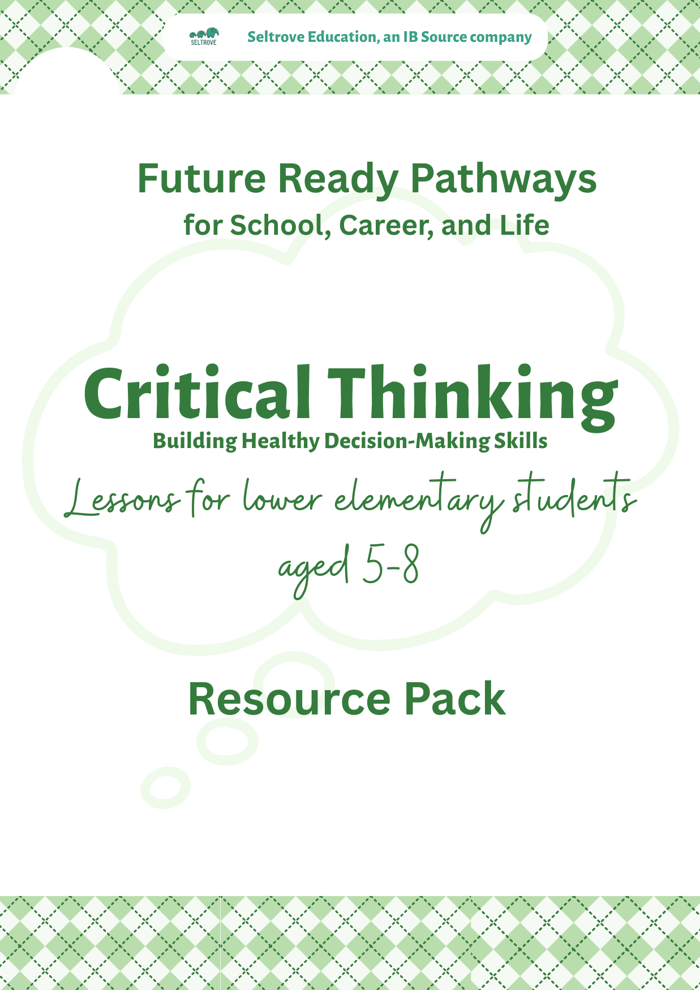
Seltrove’s Lower Elementary Critical Thinking Resource Pack helps teachers channel that natural curiosity into meaningful cognitive growth. Through stories, problem-solving, and creative exploration, it teaches students that asking questions is the key to understanding the world.
Why Early Critical Thinking Matters
Children aged 5–8 are transitioning from simple observation to reasoning. They’re learning that there can be more than one answer, and that mistakes help them grow. As UNESCO notes, “Early learning should not aim to give children all the answers, but to inspire them to keep questioning.”
When teachers encourage critical thinking at this stage, they’re laying the groundwork for:
Stronger problem-solving skills — Students learn to break challenges into smaller parts.
Improved decision-making — They begin evaluating choices (“Should I…?”) rather than reacting impulsively.
Confidence in learning — Asking and exploring builds a growth mindset that carries into upper grades.
Seltrove’s lessons include activities like Wonder Walks and Fact or Feeling?, where children learn to separate opinion from fact while observing their surroundings. This makes thinking tangible — something they can see, do, and share.
From Curiosity to Connection
“Curiosity is the engine of achievement.” – Sir Ken Robinson, TED Education
In the classroom, curiosity transforms learning from memorization into discovery. For example:
In reading, students might ask: “Why did the character make that choice?”
In science, they might wonder: “What would happen if we changed this variable?”
In social settings, they might reflect: “How does my friend feel when I say that?”
These small moments of questioning create early metacognition — awareness of one’s own thinking — a skill the American Psychological Association calls “a cornerstone of self-regulation and learning.”
Practical Classroom Application
Seltrove’s pack encourages exploration through visual and sensory play. In the “Question Detective” lesson, students practice spotting clues in images and asking deepening questions. Each question builds on the last — transforming “What’s happening?” into “Why do you think this is happening?”
Teachers can reinforce these skills daily by:
Inviting multiple answers during discussions.
Praising curiosity instead of correctness.
Modeling their own thinking aloud (“I wonder why that worked…”).
The Future-Ready Takeaway
Curiosity in Bloom: How Critical Thinking Begins in Early Learning
The goal isn’t to raise walking encyclopedias — it’s to raise thinkers. Early critical thinking builds flexible, confident learners ready for the complex challenges of school and life.
“The earlier children learn to think critically, the more resilient and adaptive they become in a rapidly changing world.” – Harvard Center on the Developing Child
🌟 Explore Seltrove’s Lower Elementary Critical Thinking Pack and help your youngest learners turn curiosity into confidence, one question at a time.
Critical Thinking: Building Healthy Decision-Making Skills K-12 Sample Pack

$0.00
Future Ready Education Pack: Critical Thinking (High School)Downloadable & Printable Resource Pack for Teachers, Homeschools, and Parents Help your students build one of the most essential life skills for success—critical thinking. This ready-to-use resource pack is designed for K-12 students… read more
Critical Thinking: Building Healthy Decision-Making Skills (Lower Elementary) Teacher Resource Pack

$79.00
Critical Thinking Pack for Lower Elementary (Grades K–2) Downloadable & Printable Future Ready Education Resource Help your lower elementary students (ages 5–8) build the foundation for smart, healthy decision-making. Part of our Future Ready Education series, this pack is designed… read more